
You Don't Have to Chase the Sunset
You Don't Have to Chase the Sunset
What years spent outdoors have taught me about light, why some spaces make us want to stay, and the choices I'm making to bring more intention into our home.
In partnership with Fat Shack Vintage.
Paying Attention to Light
I've spent years paying attention to light outdoors without really thinking about it.
On trails and expeditions, light helps me read what is changing: the terrain, the weather, the time of day and sometimes what might be coming next. There are cues everywhere, and over time I've learned to trust them.
But I'm also intrigued by what light can do to a landscape.
Over the past five years, I've found myself drawn back north a couple of times each year. There is something about the Larapinta Trail that feels a little like magic to me.
On Larapinta, I love watching the West MacDonnell Ranges absorb the changing light. Rust and burnt orange in the morning, warm ochre and red through the day, then deeper tones as the sun begins to drop. The same landscape can feel completely different within hours.


At home in the Dandenong Ranges, the light behaves differently. It filters through the canopy, catches on leaves and trunks, and creates shifting patterns across the forest floor and through the windows. As the sun moves, those patterns move with it.
Light moves. Shadows lengthen. Colours deepen and soften.
And somehow, as the light changes the landscape, it can change the pace within me too.
I've always been particularly drawn to that lower, warmer light at the edges of the day. For a long time, I think I simply knew I liked it. I didn't really ask why.
The trail is rarely still, but I often feel steady on it. The weather changes, the ground beneath me changes, the light changes. There are cues to those shifts that I've learned to read and appreciate.
There is a kind of ease in being able to orient yourself within change.
For all the curiosity I bring to being outdoors, I haven't historically brought that same perspective inside, even within my own home in the hills.
I've always loved where I live. But for years, much of the house was approached more through function than feeling. If something worked, there wasn't necessarily a reason to question it.
Yet home is one of the places where our choices can shape how we feel every single day.
What Should a Home Give Us?
As an athlete, business owner and Mumma, I've always understood home as the place I return to recover.
To lick my wounds. To refuel, sleep, repair and get ready to go again.
But recovery is not only physical.
I'm starting to understand that simply being at home does not necessarily make it restorative.
How much a home supports our recovery can depend, at least in part, on what we ask of it and how intentionally we shape the conditions around us.
The light. The noise. The pace. The spaces we gather in. The places we retreat to.
Home is where we should be able to come down from the pace of the day. To reconnect. To feel our shoulders drop. To let the nervous system settle. To regain some steadiness before we step back out into the world.
There are indoor spaces where you feel that almost immediately.
There is a photograph of Olly and Harry at Storehouse, our local roastery, that I love for exactly that reason. It is grey outside and warm inside. They are simply together in a space that seems to invite them to stay.
It made me think more about what an indoor environment can create, and what I wanted our own home to offer.
Not just how I wanted it to look, but how I wanted it to feel to live in.
A Home We've Built Slowly
There was intention in choosing this home from the beginning.
My dad and I bought it together in 2013, during a period of transition in my life. The Dandenong Ranges already meant something to us. My grandfather, Dad's dad, had lived in the hills later in his life, and we had spent a lot of time here visiting him.
The house itself had character. Built in 1990 in the style of an old English bluestone cottage, it has timber weatherboards and bedroom walls lined with bluestone in different shapes and sizes.
It also came with all the imperfection of a home that had already lived a life before us, including walls painted in different colours and federation-bar windows that interrupt some of the light and the view to the nature outside.
We live surrounded by trees, changing skies and shifting light, yet parts of the house can feel surprisingly removed from it.
For years, changing the house sat mostly in the category of things I would like to do one day.
Then the storms came through the Dandenong Ranges.
In June 2021, between Melbourne's lockdowns, our part of the mountain was hit hard. We were on one of the most severely affected streets. The house directly in front of ours was completely flattened.
Our backyard was destroyed.
Three enormous mountain ash trees came down across it, and I still can't quite believe they missed the house.
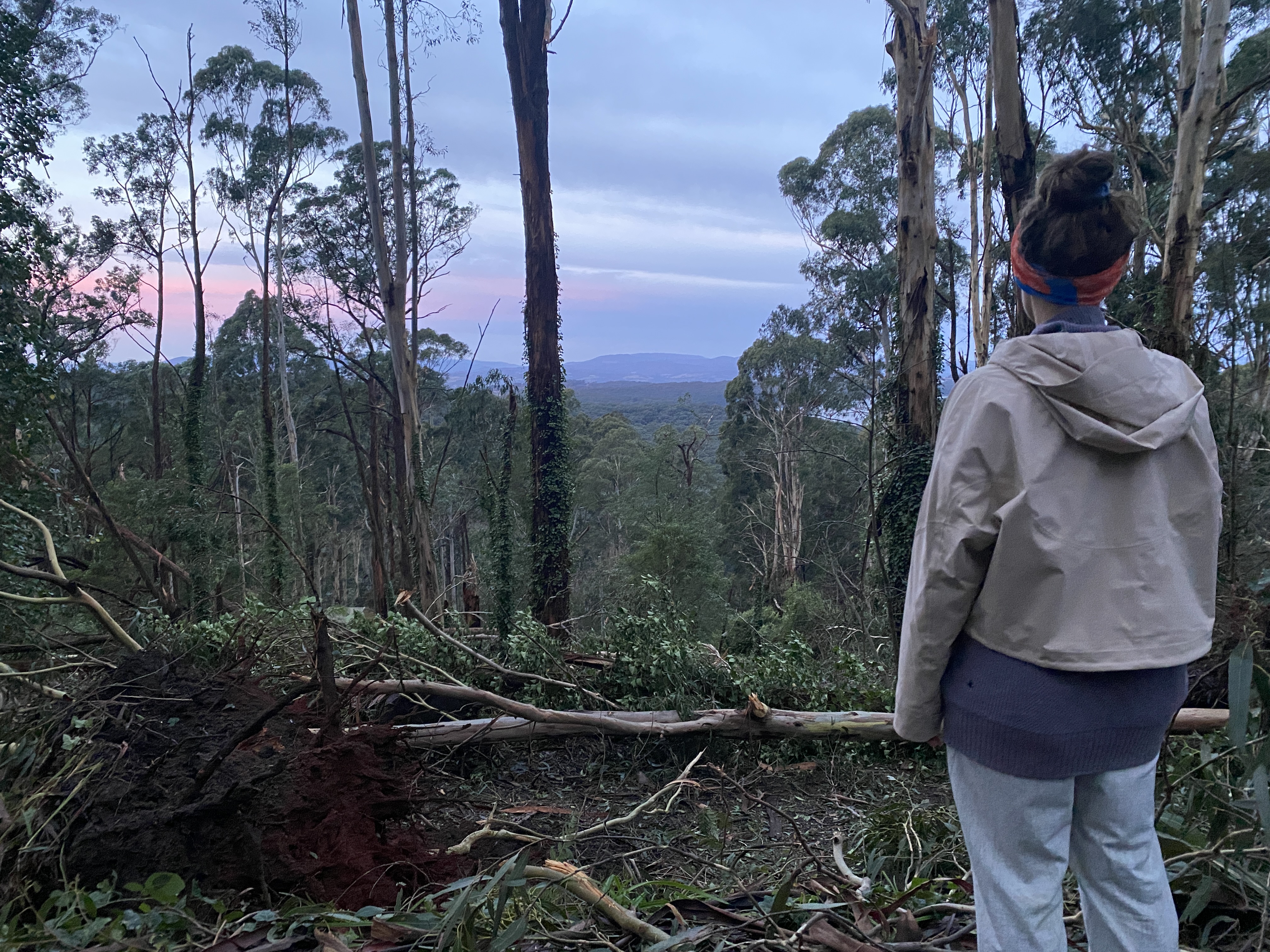
At the time, that felt like the story. We were incredibly lucky. The house was standing, and much of what we could see was damage around it.
It was only in the years that followed that I realised the home itself had been more affected than we understood at the time.
Some of that damage revealed itself slowly, bringing repairs and decisions we could no longer leave for another day.
The relationship with the home changed.
Renovation moved from something I might like to do one day to something I had to engage with.
Once I was making those decisions, I began looking at the house differently. Not just at what needed fixing, but at how we actually wanted to live in it.
From Choosing Lights to Asking Why
For a long time, I had largely the same lighting that was already in the house because, well, there was nothing particularly wrong with it.
The lights worked.
I knew the downlights could feel harsh, particularly at night, but I didn't really think there was much I could do about it.
Lighting became one of the places I started to look more closely.
I went straight to Fat Shack Vintage, a Melbourne family-owned business I had followed for years.
I had always been drawn to the character of their lights: the metals, the reeded glass, the softer curved fabric forms, and the sense that those materials belonged in a home with timber, stone and a little imperfection.
At first, I thought I was choosing fittings.
Then the screenshots of favourites started adding up, and I realised that "looks good" was not really the question anymore.
Working with Joanna and the Fat Shack team introduced me to people who had spent years thinking deeply about something I had barely considered.
We talked about where a fitting would live, what materials suited that position, how those materials would change over time, how to layer light, and how the globe you pair with a fitting can change the cast, brightness and depth of the light.
It made me think about the light we wake up to, work under, cook in and leave on at the end of the day.
I started asking different questions.
Where does the morning light fall?
What feels harsh at night?
Why do some spaces make us want to stay?
Why am I so drawn to lower, warmer light at the end of the day?
And what is actually happening in our bodies when light changes?
The more I learned, the more it resonated with what I had already experienced outdoors.
What I've Learned About Light
Light is one of the signals our bodies use to understand time.
The pattern of brighter days and darker nights helps regulate our circadian rhythm, our internal body clock, which is involved in sleep and alertness.
A 2022 expert consensus on light exposure in healthy adults recommends brighter light during the day, lower light in the hours before bed and a dark sleeping environment, while still maintaining enough light for comfort and safety.
What I found particularly interesting was how differently we can respond.
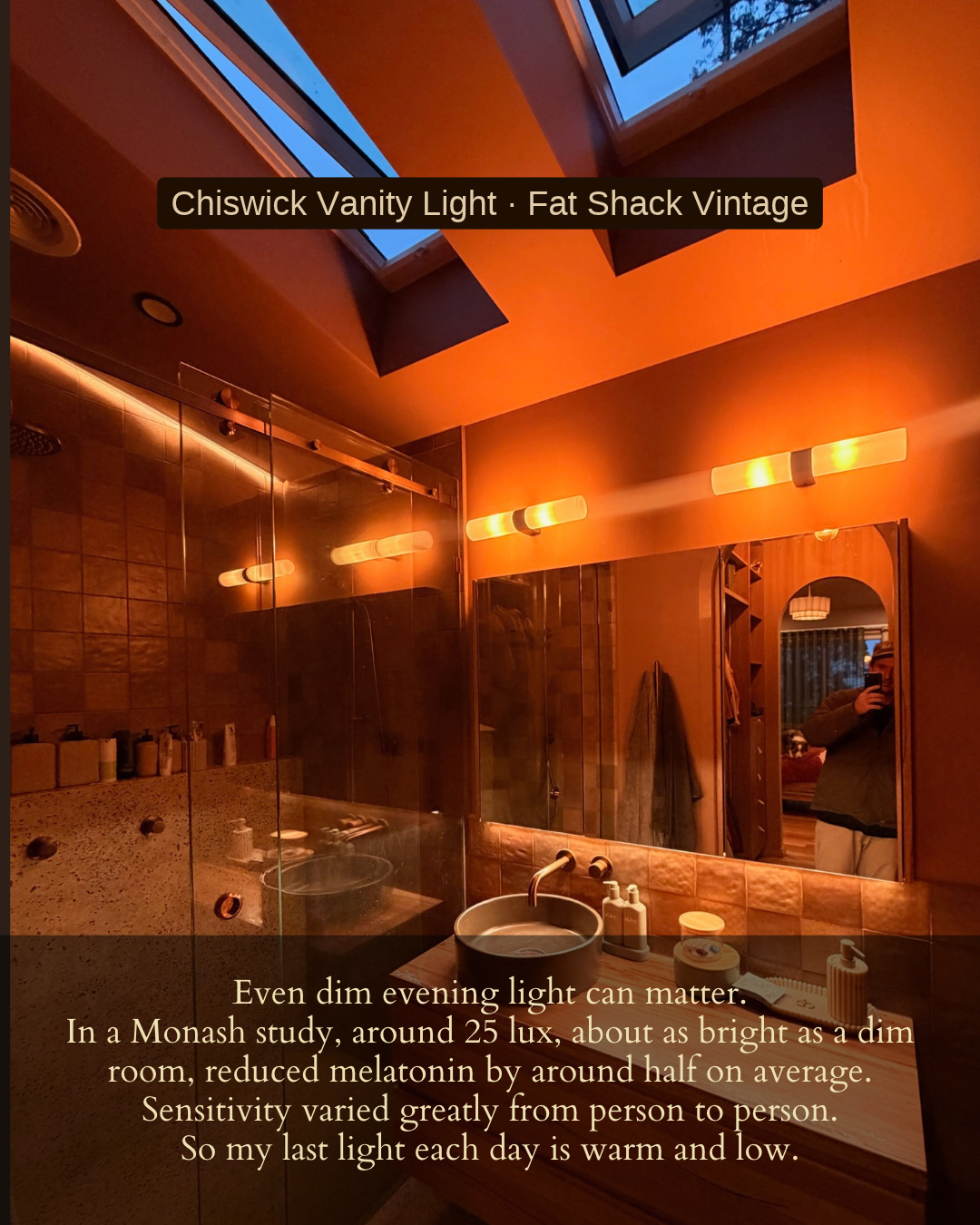
Research from Monash University found that relatively dim evening light could suppress melatonin by around half on average, although sensitivity varied enormously from person to person (Phillips and colleagues, 2019).
That is one reason we use lower, warmer lighting in our ensuite before bed. It changes the feeling of the room and helps us make that transition towards the end of the day.
There isn't one magical warm bulb that will make every person calm or guarantee better sleep.
Brightness, timing, spectrum and duration all matter. And so does the person under the light.
Research looking at lighting in homes has also found associations with sleep, mood and other health outcomes, although the evidence is still developing.
For me, the useful takeaway isn't to turn our home into a laboratory.
It is to become more observant.
Starting With the Light That Is Already There
One of the biggest shifts has been paying closer attention to daylight before deciding what artificial light we need.
Where does the morning light fall? How does it change through the day? Where do we naturally want to sit?
A place that feels beautiful at 8am may have uncomfortable glare at 4pm.
Sometimes the useful change is as simple as opening curtains earlier, clearing something that blocks a window or moving a chair into the light.
I've become more willing to live with a room before deciding what it needs.
The timber, bluestone and deeper colours in our house all interact with daylight differently. We've also used colours from the Breathe x Haymes palette, which draws on the Australian landscape, and I love seeing how those tones shift as the daylight changes.
What Happens When the Day Winds Down?
The evening is where I notice the difference most.
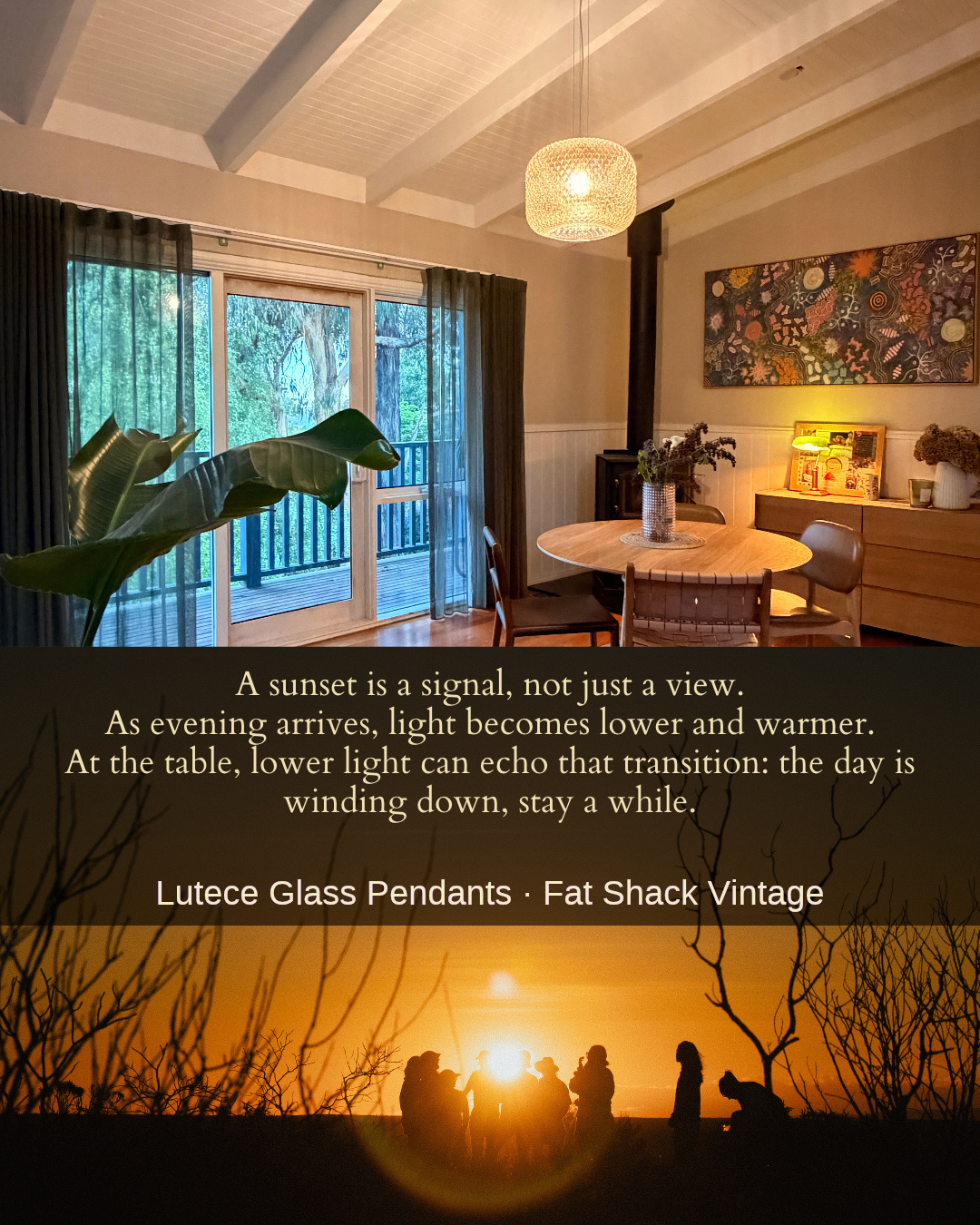
Outside, the transition happens gradually. The light lowers. The colour changes. Shadows lengthen.
Inside, we can do almost the opposite: turn on bright overhead lights and leave the environment essentially unchanged until we go to bed.
I've become much more drawn to layers of light instead.
The Chiswick Vanity Light in the bathroom gives us another option rather than relying entirely on bright overhead lighting.
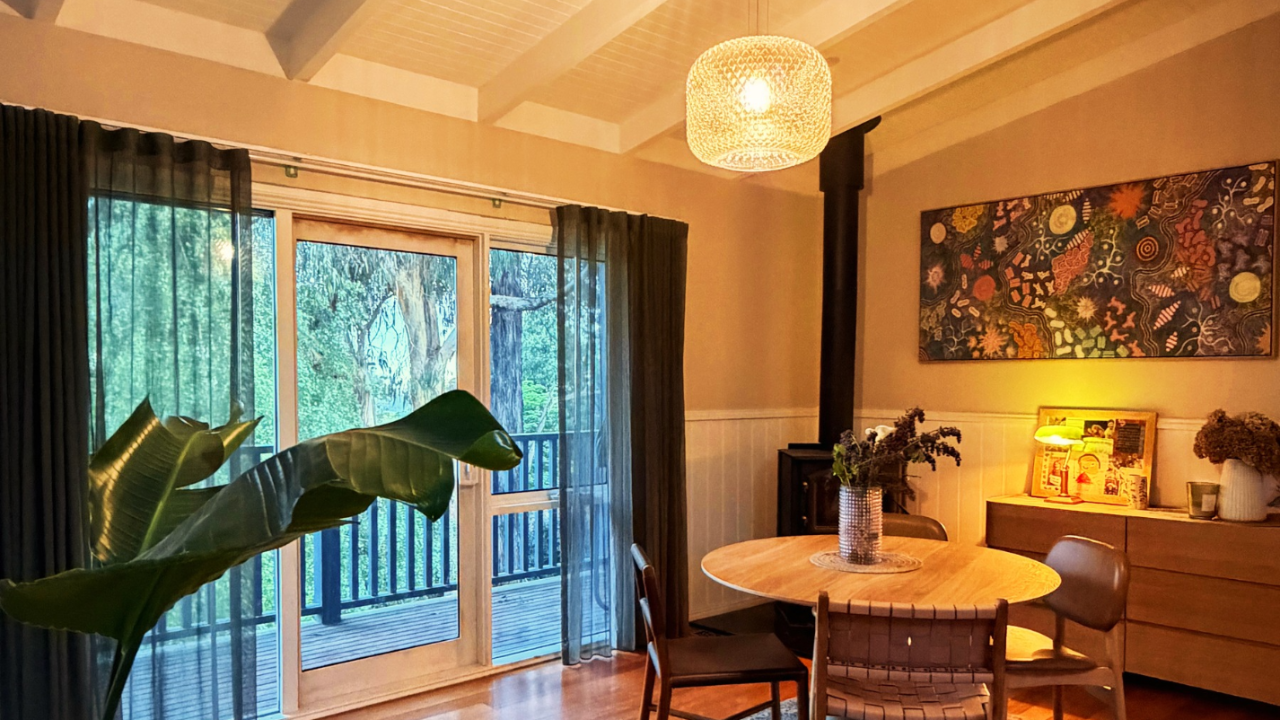
The Lutece Glass Pendants sit above our dining table, a place where we eat, talk and spend time together. Lower light there can echo some of that transition I'm drawn to outdoors: the day is winding down, stay a while.
I'm also learning not to confuse warm with dim. A bulb can look beautifully warm and still be incredibly bright.
What Light Interacts With Matters Too
The more I paid attention, the more interested I became in what light interacts with.
I have always loved reeded glass. I loved it enough to have a bespoke arched sliding door made with reeded glass for our bathroom, long before I had really thought about why I was drawn to it.
Now I notice what it does to light.
Rather than allowing light to pass through as one flat source, the ridges distort and diffuse it. The light breaks across the surface, creating texture, softer edges and movement.
The Dakota Reeded Glass lights are a good example.
They're sold as wall lights, but we installed them on the ceiling in the wardrobe.
The reeded glass gives the light texture and softens the exposed source. It is a very different feeling from switching on a bright ceiling light, which is exactly what I wanted in a space we use at the beginning and end of the day.
Copper behaves differently again. It catches warmth and reflects it back, then changes over time as the material develops a patina. In a home already full of timber and stone, I like that sense of ageing.
Fabric changes the light again.
Softer curved shades can diffuse light more gently, taking some of the hardness out of an exposed source. The Trenerry Tiered Fabric Scallop Pendant brings that softer quality into the bedroom.
It has made me understand that light is not experienced in isolation.
Glass, metal, fabric, stone and timber all change what we see and how a room feels.
Even the globe matters. Brightness, warmth, position and the material around it all influence what a fitting actually does once it is in the room.
Lighting That Can Live With Us
Another part of working with Fat Shack Vintage that I've valued is thinking beyond what something looks like the day it arrives.
Where will it live? How will the material change? What does the position require?
A fitting used near water or outdoors may need an appropriate IP rating depending on its exact location, and that is something to work through with your electrician before ordering.
Being able to talk these decisions through with people who know the products has been genuinely useful. It is much easier to make a considered decision when you understand the finish, dimensions and installation requirements rather than choosing from a photograph alone.
A good decision is rarely just about whether I like something.
It is whether it suits the space, how we live, what already exists around it, and whether we are likely to enjoy living with it years from now.
Paying Attention
I'm still learning what works here.
There are unfinished rooms and decisions we haven't made. There will almost certainly be things I change my mind about.
But perhaps that is part of what I have learned outdoors too.
The landscape is never static.
Light moves. Weather moves. Seasons move.
You learn to notice the cues and respond.
I don't want to recreate nature inside our home.
I want to become more attuned to what it has been showing me all along.
To notice where the morning light lands. To recognise when we need more light, and when we might need less. To notice how different materials change the light around them.
And to make more considered choices about the place we return to every day.
We don't have to chase the sunset.
Sometimes we simply need to pay closer attention to what it has been teaching us.
Research and Further Reading
- Phillips and colleagues (2019). High sensitivity and interindividual variability in the response of the human circadian system to evening light. PNAS.
- Burns and colleagues (2023). Day and night light exposure are associated with psychiatric disorders: an objective light study in >85,000 people. Nature Mental Health.
- Osibona, Solomon and Fecht (2021). Lighting in the Home and Health: A Systematic Review.
- Brown and colleagues (2022). Recommendations for daytime, evening, and nighttime indoor light exposure to best support physiology, sleep, and wakefulness in healthy adults. PLOS Biology.
Healthy Homes explores how the spaces we create and the ways we live in them can support our wellbeing, recovery and relationships. Start the conversation.